
By Christopher Strohsahl, President and CEO and Michael Lutz, Chief Business Officer, Drummond Scientific Company
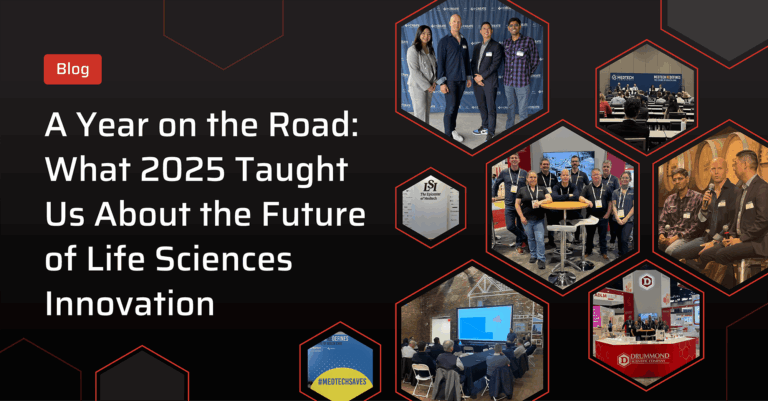
Drummond Scientific spent 2025 on the move, attending prominent industry events throughout the U.S. and Europe and connecting with the global leaders (startups, academics, industry veterans) tackling some of the biggest challenges in healthcare innovation. These events weren’t just about showcasing technology, products, or industry know-how, they were an opportunity to listen to what the industry is struggling with, where it is finding momentum, and how, as a manufacturing partner, we can help accelerate the path from the drawing board to market.
One year, over a dozen conferences, and tens of thousands of miles later, here are the themes that stood out.
From Idea to Impact: Partnering Early to Build Better
Drummond entered 2025 determined to expand what’s possible for the innovators in our network. We take great pride in supporting early-stage developers with our venture manufacturing services, and at every event we attended this year, one theme kept surfacing: the earlier you consider how a product will be manufactured at scale, the faster innovation can translate into real-world impact.
At Life Science Intelligence (LSI) USA 2025, both investors and founders underscored the importance of integrating production planning into early development discussions. Throughout the conference, every conversation reaffirmed how critical the support of industry partners is for young companies. When teams can articulate a realistic manufacturing path before their prototype is even final, investors gain confidence and traction grows.
At Wilson Sonsini Goodrich & Rosati’s (WSGR) Medical Device & Digital Health Conference, we continued to see this same pattern emerge as business experts, investors, and innovators discussed the challenges of bringing new technologies to market. The conversations reinforced that successful commercialization requires more than just great science. It demands early strategic planning around manufacturing, regulatory pathways, and scalability.
MIT’s IdeaStream: NextGen took this learning to the next level. Academic groups are now building commercialization milestones into their research roadmaps, not as an afterthought but as a core part of innovation. We participated in discussions about bridging the gap between discovery and scalability, offering our perspective on how early design choices can speed or slow the journey to manufacturability. These conversations make the transition from lab to line more successful.
Finally, at BIO International, innovators from across the globe showcased what’s possible when teams pool expertise across geographies, disciplines, and stages of development. Everywhere we turned, the same themes kept resurfacing: no one brings a breakthrough to life alone. The scale and diversity of collaboration there reinforced how important it is to build manufacturing partnerships that are flexible, transparent, and rooted in shared objectives.
When innovators bring manufacturing into the conversation early, they reduce risk, accelerate timelines, and ultimately build better products.
Manufacturing Efficiency, Scale, and Accessibility
From coast to coast, diagnostics leaders were focused on manufacturing with greater speed, precision, and scalability.
One of our most significant moments of the year came at the Association for Diagnostics & Laboratory Medicine (ADLM) 2025 Conference, where Drummond had our largest presence to date. With a full booth and a team of eight on the ground, we had the chance to meet with longtime peers and new collaborators while showcasing two technologies from partners pushing the boundaries of near-patient diagnostics, the ADx 100™ Point-of-Care System from AmplifiDx and the Halo System from Hyperion Biosystems. Together, these product demos gave attendees an up-close look at what thoughtful engineering and scalable manufacturing can accomplish in concert.
At the University Lab Partners BARDA ReadyDetect Launch, the focus shifted to next-generation diagnostics innovation. Chris had the opportunity to join a panel discussing how to bridge early-stage discoveries with real-world deployment, as part of BARDA and I-CREATE’s ten-million-dollar ReadyDetect Competition, which is aimed at accelerating high-performance, low-cost antigen tests for use in the home or in the field. The conversations there clarified both the urgency and the opportunity in making diagnostics more accessible.
Traveling next to The MedTech Conference, discussions centered on patient-centered design, sustainability, and the role of digital infrastructure in delivering reliable, scalable healthcare technologies. The event also underscored the importance of funding readiness, regulatory clarity, scalable supply chains, and technology designed for market entry. We’re proud to deepen our involvement in this community by joining AdvaMed as a member. Becoming part of this community aligns with our commitment to responsible innovation and gives us a stronger platform to advocate for manufacturing practices that accelerate access, improve quality, and support early-stage companies navigating a complex regulatory landscape.
At MD&M Midwest in Minneapolis, and PACK EXPO 2025, in Las Vegas, we saw the latest advancements in manufacturing robotics, packaging and processing, and critical components of any scalable manufacturing strategy. These events reinforced just how interconnected manufacturing and packaging design are with product quality, throughput, and long-term supply stability.
Traveling overseas to MEDICA 2025 in Düsseldorf, Germany, we connected with innovators in diagnostics and medical devices at one of the world’s largest medical B2B trade fairs. This was an opportunity to connect with overseas customers and potential customers, reinforcing how working with Drummond can help provide a reduced path to market by being a scaling manufacturing partner. The event showcased how automation, robotics, and AI-enabled workflows are reshaping production, with smart supply chains and advanced quality systems driving new levels of efficiency and reliability.
Beyond conferences, we also spent meaningful time closer to home, regularly traveling to Boston to collaborate with StudioDx, a growing community for diagnostic innovators. Their Network & Nourish sessions have become an incredible forum for connection, mentorship, and sharing lessons learned about scaling diagnostic technologies.
The Future is Digital, Automated, and AI-Powered
Whether in digital health or advanced production environments, the future of manufacturing will be defined by intelligent systems.
At the Advanced Lateral Flow Conference (ALFC), discussions centered on what truly drives growth in lateral flow diagnostics: the use of AI as a catalyst for innovation. Using AI to capture more precise diagnostics on an LFA platform represents a significant evolution in this well-established technology, opening new possibilities for accuracy and accessibility in point-of-care testing.
At the American Telemedicine Association (ATA) Conference, the focus was squarely on digital, automated, AI-powered technology. While current attention centers on at-home diagnostics through wearable technologies and AI-powered apps, we understand that the next evolutionary step in at-home monitoring will be at-home diagnostic tests. These tests can leverage the platforms promoted by the ATA to provide real-time diagnostics and health monitoring around the world, regardless of location or access to healthcare systems.
From smart supply chains to advanced quality systems, we saw how digital intelligence is driving a new level of efficiency and reliability across diagnostics and medical devices. The bottom line? Smart investments in automation and integrated manufacturing systems today will be pivotal for accessible and scalable diagnostics tomorrow.
Revolutionizing Reproductive Health Through Innovation
At the American Society for Reproductive Medicine (ASRM) 2025 in San Antonio, we joined our partner, IVF On Demand, in a global collaboration to advance reproductive health. As co-exhibitors, we demonstrated how our partnership helps labs deliver greater precision, efficiency, and accessibility in IVF. As progress in this space continues to accelerate and expand across every stage of family building, the discussions at ASRM reminded us that the most meaningful innovation starts with empathy. They help us better understand the real people and families who benefit from our work and support the collective mission to improve reproductive health worldwide.
Top Takeaways
Finally, here’s a quick roundup of the key takeaways that reminded us why collaboration is the catalyst for progress.
Innovation Hotspots: So much of the year’s momentum came out of Southern California, where LSI USA, ULP, WSGR, The MedTech Conference, and ALFC demonstrated just how vibrant and forward-looking the region has become. From startup founders to global strategists, the conversations there reflected the pace and creativity driving life sciences forward.
Community in Action: When people come together with shared purpose, barriers fall and ideas move faster. We’re incredibly proud of our partnerships with StudioDx and University Lab Partners, and look forward to carrying that momentum into the new year.
Conversations That Stuck With Us: Throughout the year, we continue to hear and participate in discussions around developing an ecosystem to bring diagnostic devices to scale faster and with less capital. Similar to the playbook used to bring therapeutic drugs to market, diagnostic and MedTech companies can leverage existing industry partners rather than building everything in-house. Therapeutic developers often rely on external resources to advance products with lean teams of founders and researchers. Diagnostic companies can take the same approach by working with product development firms, manufacturers, CROs, regulatory consultants, and other partners to move devices toward commercialization.
This model helps teams stay efficient while creating stronger outcomes for investors. It can also make early-stage diagnostic companies more attractive to additional funding sources, such as angel investors and family offices, by demonstrating a clearer path to market without the need for multiple large funding rounds. We are excited to see how these conversations continue to grow and develop, and how Drummond can help drive the diagnostic device market forward.
As we look ahead to 2026, our focus remains on advancing scalable, high-quality manufacturing solutions that make life-changing technologies possible. We’ll continue to expand our partnerships with innovators, invest in automation, and refine our venture manufacturing approach, helping build a path from creation to impact